 FAB Binder Organizer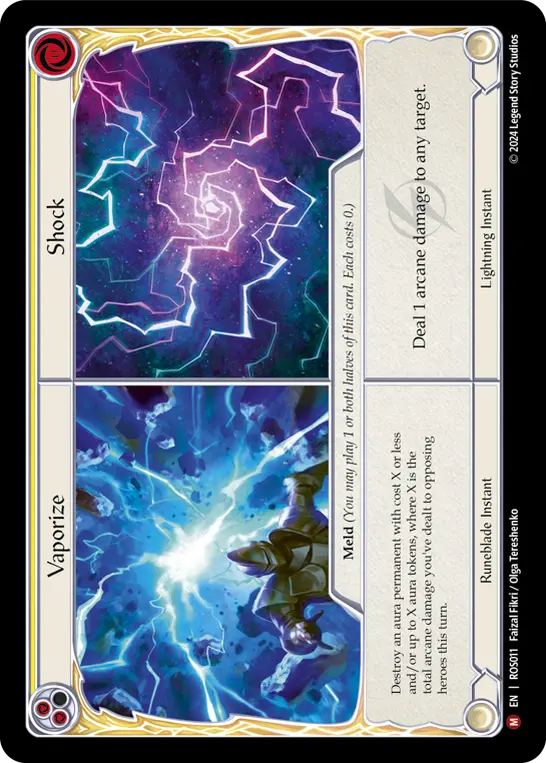
Vaporize // Shock (Yellow)
Meld
Destroy an aura permanent with cost X or less and/or up to X aura tokens, where X is the total arcane damage you've dealt to opposing heroes this turn.
//
Deal 1 arcane damage to any target.
Destroy an aura permanent with cost X or less and/or up to X aura tokens, where X is the total arcane damage you've dealt to opposing heroes this turn.
//
Deal 1 arcane damage to any target.
Rulings
From the Rosetta + 1st Strike release notes
- Vaporize||Shock is a Lightning Runeblade card and can only be included in your card-pool if you can include Lightning Runeblade cards.
- The value of X is based on how much arcane damage you’ve dealt to opposing heroes this turn when Vaporize resolves on the stack, not when you first play it.
- Arcane damage dealt to non-hero cards (e.g. allies) does not contribute toward the value of X.
- Vaporize is not a targeted effect. When Vaporize resolves, you will choose which aura permanent and/or aura tokens to destroy.
- When Vaporize resolves, if you choose to destroy aura tokens, you may choose to destroy any number between 0 and X; if you choose 0, you do not destroy any tokens.
- When Vaporize resolves, you may choose not to destroy any aura permanent or aura tokens. (i.e. choosing only to destroy 0 tokens).
- Base cost is the printed cost value on a card. (Located at the top right corner of a card.)
- Destroyed cards go to their owner’s graveyard. If a token is destroyed (leaves the arena), it ceases to exist.
- If you meld Vaporize||Shock, you will resolve the Shock side of the card the first time the melded-card’s layer resolves. Any arcane damage dealt to an opposing hero will contribute to the value of X when you resolve the Vaporize side of the card when the melded-card’s layer resolves the second time.
Keyword notes
Meld - You may play 1 or both halves of this card. Each costs X.
- Meld is an ability keyword and is found on split cards in this set.
- When you play a split card with the Meld ability, you must announce if you will meld the split card or announce which side of the split card will be played. If you choose to meld a split card, it is considered to be a single card with the properties (name/textbox/typebox) of both sides.
- After you announce the melded card, continuous effects that apply to either side of the split card will apply to the melded card.
- After you announce the melded card, continuous effects that apply to either side based on their properties (name/textbox/typebox) apply to the melded card. E.g. a melded card that has Wizard on one side and Earth on the other, is subject to effects that apply to either Wizard or Earth cards.
- You may only play a melded card if you meet the requirements for playing a card with the combined properties of both.
- If you want to play a melded card that has the action type on one of its sides, you can only do so on an empty stack and it will cost 1 action point, even if the other side has the instant type. If an effect would allow you to play the melded card as an instant, you do not need to play it on an empty stack or pay an action point.
- The base cost of a melded card remains the same as the printed cost.
- The starting resource cost to play a melded card is TWICE the base cost of the card (i.e. you start with paying for the base cost for each side you’re playing). Then you apply cost modifications.
- Effects that increase/decrease the
 cost of playing a card (e.g. Frostbite), only increase/decrease the overall cost required to play the melded card. For example, you want to play a melded card with a base cost of 2 and you control a Frostbite. The total resource cost to pay is 5: 2 for each half, plus 1 due to the Frostbite effect.
 - When playing a melded card, the card will be placed as a single layer onto the stack. This layer will be resolved twice. The first time the layer resolves on the stack, the right-side of the split card will resolve its abilities and generate effects first. The second time the layer resolves on the stack, the left-side of the split card will resolve its abilities and generate their effects.
- Players get priority between the resolution of each side of the card. The turn player receives priority after the melded card resolves the first time (i.e. right-side of the card), but before it gets resolved the second time (i.e. left-side of the card).
- The melded card stays on the stack after resolving the first time. It can be targeted by effects such as negate.
- If a melded card is negated or otherwise fails to resolve a second time while on the stack, the controller does not gain an action point from go again.
- If either half of a melded card gets go again, the entire melded card has go again. When a melded card is fully resolved (i.e. it resolves the second time), if the card has go again the controller gains an action point.
- If a continuous effect would grant a melded card an ability that triggers when a card resolves, that ability would resolve when the melded card’s layer resolves on the stack a second time.
TalentLightning
ClassRuneblade
TypeInstant
Cost0
Arcane1
PitchYellow
KeywordsMeld
Legal inClassic Constructed, Blitz, Living Legend, Ultimate Pit Fight
ArtistsFaizal Fikri, Olga Tereshenko
 Buy ROS011 on TCGplayer ↗
 Versions
Price history
ROS011More from Rosetta
Planning where this card lives? Lay it out in a binder or browse the full card database.