 FAB Binder Organizer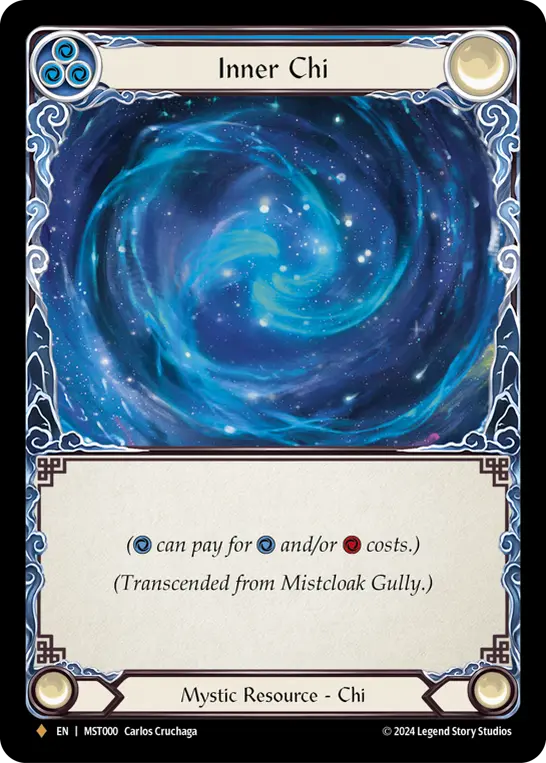
Inner Chi (Blue)
Rulings
From the Part the Mistveil release notes
- Mistcloak Gully triggers at the beginning of each player’s end phase, not just the end phases of the player who controls it.
- When Mistcloak Gully’s trigger resolves, whether you’ve pitched, played or defended with a blue card is checked. If neither of these actions were performed by the controlling player that turn, Mistcloak Gully will be destroyed. If at least one of these actions were performed, then the trigger will look to see if all three actions were performed; if so, then you will transcend Mistcloak Gully into an Inner Chi and place it into it’s owner’s hand.
- In a multiplayer game, if the first attack that targets you during a turn has its target changed due to an effect (e.g. Taipanis) while you control a Mistcloak Gully, the attack against the new target will no longer have the -1{p) applied to it. If during the same turn, you become the target of another attack, the -1
 debuff will not be applied since it is no longer the first attack that targets you this turn.
 - During the end phase, if you control Mistcloak Gully that is owned by another player and you have played, pitched and defended with a blue card this turn, transcend Mistcloak Gully. The player who controls Mistcloak Gully performs the transcend effect and is considered to have transcended; however, the Inner Chi is placed into its owner’s hand.
- During the end phase, if you control Mistcloak Gully that is owned by another player and are reduced to 0
 (e.g. Blood Debt) while Mistcloak Gully’s trigger is waiting to resolve on the stack, Mistcloak Gully is simply cleared. Before the next triggered layer on the stack begins to resolve as if all players passed priority in the end phase, players that have no remaining health lose the game, clear all objects they control, and remove all objects they own from the game. This includes any unresolved triggered-layers created by Mistcloak Gully as they would be controlled by the player who lost.
 - You choose the modes when you play this card. To be able to choose 3 modes, you must have already played another blue card this turn before playing this card.
- You may not choose the same mode more than once.
- If you’ve played another blue card this turn, you must choose all three modes. Otherwise, you must choose one of the modes.
- If you choose the 2nd mode, you may choose not to banish any cards in an opponent’s graveyard.
- You would put a +1 counter on each aura with ward you control, including the two Spectral Shield tokens created from resolving this ability’s first mode. If you control any auras on the stack that are waiting to resolve, you would put a +1 counter on those auras as well.
- If you’ve played another blue card this turn, you must choose all three modes. Otherwise, you must choose at least one of the modes.
- If you choose the 2nd mode, Crouching Tigers you control get +1 this turn. You control Crouching Tigers that are in the arena or on the stack.
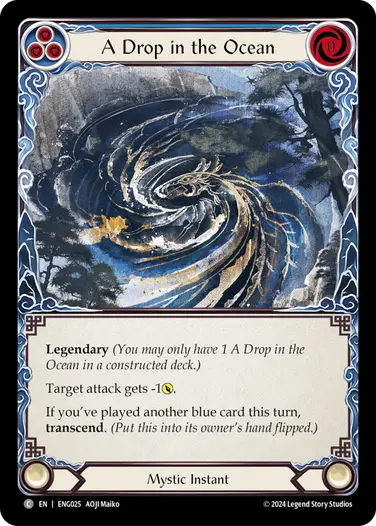
- This card will transcend into Inner Chi if you’ve played another blue card (other than this one) this turn before this card resolves.
- You can target an attack controlled by the opponent.
- You cannot target defending attack action cards because they are not attacks.
- If there are no cards in your opponent’s graveyard, you cannot play this card since it does not have a legal target.
- If the targeted card is no longer in your opponent’s graveyard by the time this card’s layer resolves, this card’s layer fails as there are no remaining targets for the targeted effect and this card does not transcend.
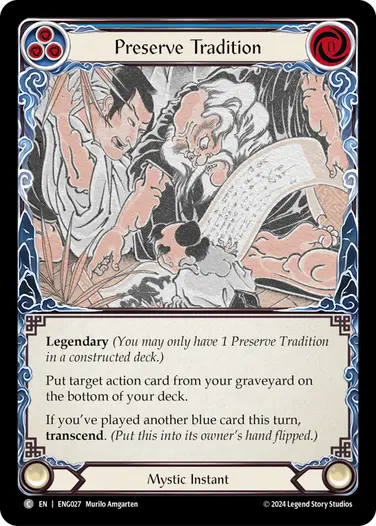
- If there are no cards in your graveyard, you cannot play this card since it does not have a legal target.
- There is no priority to play or activate abilities during the resolution of a layer.
- If you have no cards in your deck zone and you are required to shuffle, the zone is still considered shuffled.
Older rulings (3)
- If the attack-source of the active chain link is the targeted attack and that source is no longer on the combat chain by the time this card’s layer resolves, this card’s layer fails as there are no remaining targets for the targeted effect and this card does not transcend.Changed 2026-02-13The layer still resolves: only the targeted -1 power effect fails. If you have played another blue card this turn, this card still transcends into Inner Chi.
- If the attack gets go again before the link step, the attack’s controller will gain 1 action point from the go again. If you play and resolve this card during the link step, the attack’s controller will not gain 1 action point from the go again.Changed 2025-01-31The Link Step no longer exists (31 January 2025): the action point from go again is given as the Resolution Step begins, right after the Damage Step; read "link step" as "the start of the Resolution Step". Go again gained after that gives nothing.
- If the targeted card is no longer in your graveyard by the time this card’s layer resolves, this card’s layer fails as there are no remaining targets for the targeted effect and this card does not transcend.Changed 2026-02-13The layer still resolves: only the targeted effect fails. If you have played another blue card this turn, this card still transcends into Inner Chi (the rules update uses Preserve Tradition as its example).
Other faceA Drop in the Ocean
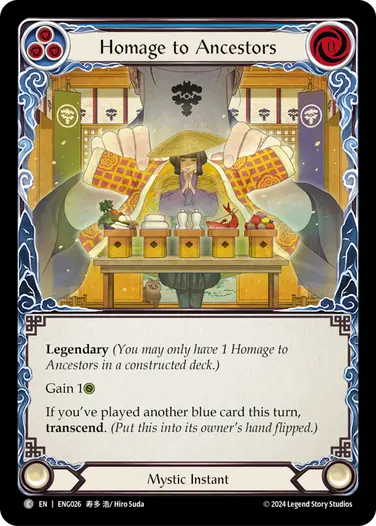
Other faceHomage to Ancestors
Other faceMistcloak Gully
Other facePass Over
Other facePath Well Traveled
Other facePreserve Tradition
Other faceRising Sun, Setting Moon
Other faceSacred Art: Immortal Lunar Shrine
Other faceSacred Art: Jade Tiger Domain
Other faceSacred Art: Undercurrent Desires
Other faceStir the Pot
Other faceThe Grain that Tips the Scale
 Buy MST000 on TCGplayer ↗
 Versions
Price history
MST000RFMore from Enigma Blitz Deck
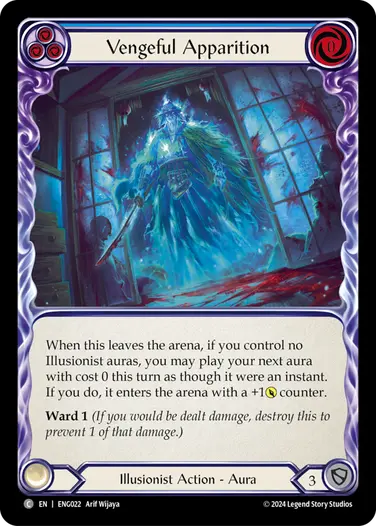
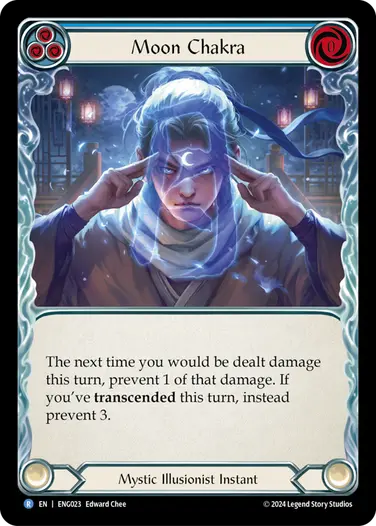
Planning where this card lives? Lay it out in a binder or browse the full card database.